Editor's note: true to form, as soon as I started this we lost internet. In addition to the usual litany of power outages and internet failures, and the unusual blow-up of the transformer/sub-stations, it seems not only was this area of town or even our complex - all of two buildings - adversely affected - it was THIS building. After weeks of calls and many service trips and several teasers of internet that lasted more than five minutes, a technician at 9 pm on a Sunday night "replaced some things" and we are back!
My big birthday present for my BIG birthday was a trip to Zanzibar. Zanzibar had always intrigued me as it was one of those places everyone heard of but did not know very much about. It lived up to my expectations. It has a fascinating history and is a real "melting pot" of diverse cultures, conquerors, interlopers and squatters. So, on to a a pictorial "Road to Zanzibar".

Well, actually "in the Air to Zanzibar". The Captain invited the kids up to the cockpit.-
Zanzibar is off the cost of mainland Tanzania. For those of you old enough to remember the African country of Tanganyika, Tanzania is the merging of Tanganyika with Zanzibar. And for those of you who remember the 60's and social activisim, this was done under Julius Nyerere. It is an archipelago of 50 plus islands. The main island is Unjuga. Most of the islands are small and uninhabited. The islands were a part of the trade routes for middle eastern and European traders. The first immigrants to settle in Zanzibar were Shirazi Persians who arrived in the 10th century, fleeing turmoil in their native country (history does repeat). They inter-married and disappeared as a distinct ehtnic group. Portuguese occupied the island in the 16th century. Their legacy remains in the remnants of a fort, a variation of bull-fighting on the second largest island, and a few vocabulary words, such as cassava. The pivotal and most defining of the colonisations were the Omani Arabs who established a brutal regime built on slave trading, forced labor and exploitation.
The British negotiated a treaty with the Sultans of Oman in the late 1700's and then pushed an agenda to pressure the end of the slavery through a policy of "gradualism" and their own colonization (gradualism defined as 100 plus years before personal slaves were banned in addition to slave trading).The Brits continued to recognize Zanzibar as an Arab state and stayed in bed with the devil so to speak. "Independence" was granted in 1963 but power handed to a pro-Sultan coalition. The Zanzibar Revolution in 1964 came at the crossroads of the cuntry moving from a constitutional monarchy to a an authoritarian Arab state. The new government confiscated Arab property, banned the Sultan and nationalized land and services.
Stone Town, also known as Zanzibar town, is a maze of narrow streets resembling medinas and shows evidence of its various ethnic and cultural roots. It is a designated UNESCO site with much potential and at this no point almost no funding. Many historical buildings are in various stages of decay, but the overall effect is fascinating. It faces the Indian ocean and continues to be defined to a large extent by water and a fledging tourist industry.


Zanzibar is predominately Islamic, about 89% of the population. However, they do not follow sharia law - and they get a fair number of Italian toursits - so the effect is a fairly liberal society.
The missionaries were not without some success; the remaining 11% of the population are practicing Christians.
The missionaries were not without some success; the remaining 11% of the population are practicing Christians.


 Home of Tippu Tap, an infamous Arab slave trader. When he died, he had 10,000 personal slaves. The house is now a squatter's tenement, complete with hanging laundry, cooking fires, barefoot children and no electricity. This man lives on the top floor, was extrememly knowledgeable (albeit a little eccentric) and gave us a tour and oral history of the building.
 |
| House of Wonders - built as a Sultan's palace, later the offices of the British Colonial Government, now a museum. |
 |
| House of Wonders - macro view |
 |
| Inside a slave holding cell. There were two rooms: one for men and one for women and children |
 |
 |
| Where else can you visit a historical site, attend mass, eat, get your hair cut and buy art? |
 |
Memorial to slaves 
Dining out - vendors in the park versus roof top at the hotel. Actually the food was comparable (but not the ambiance).
|
We interrupt this posting for an important message

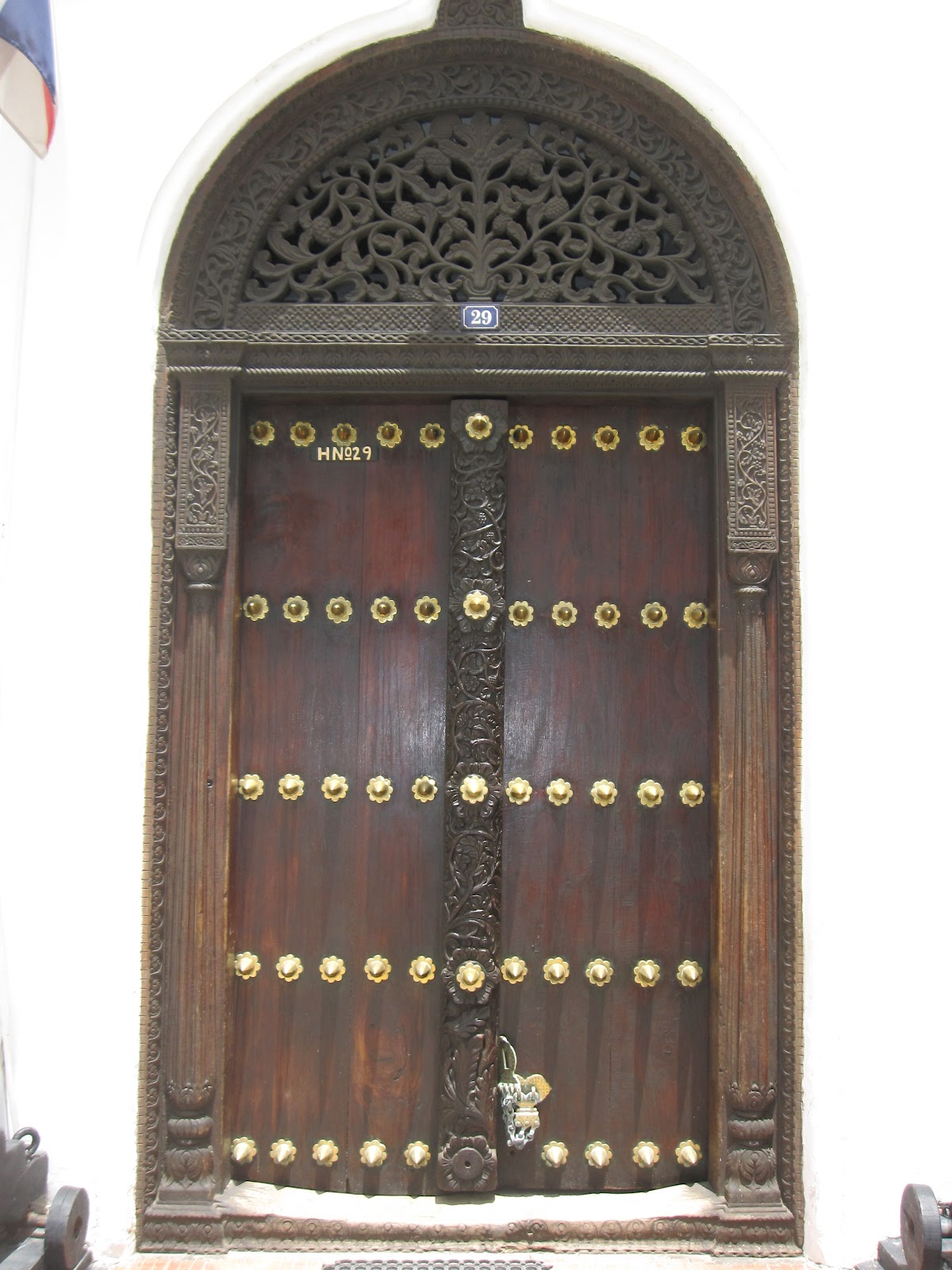
I'll Take Door Number One...

Stonetown is characterized - at least in those buildings still standing - by its doors, not unlike northern Africa and other parts of the Arab world. They are notable for their size and brass fittings.
The Indian immigrants introduced the arched doorway. Prior to that the doorframes were squared off.


Swimming with the Dolphins
We got up early one morning and headed south to an area known
for its dolphin colonies and migrations. "Swimming with the dolphins"
 translates into getting a small boat which cruises the water for dolphin sightings. Once spotted, said boat revs as fast as it can to get the site, and the guide yells "Jump NOW Madam", whereupon the dolphins dive for the bottom. The trick is to get there before they dive. We actually did have some good swims as well as some good top down views.
Monkey see, monkey do...
 Dolphins in the morning and monkeys in the afternoon. We came back through Jozani Forest, a protected area for the Red Colobus monkey unique to Zanzibar.

East to the beach...via a Spice Plantation
Zanzibar is reknown for its spices; hence the nickname the "Spice Islands". The original plantations were each subdivided among thirty families after the revolution and some continue to operate (more or less). The original thirty now incorporates several generations and the number of dependents has increased exponentially. A number of plantations now exist on a combination of crops and a very nascent tourist trade.

Then to the beach - aka the Italian Rivera of Zanzibar. For some reason the Italians Amore the beaches (although pay no attention to Stonetown). Fortunately for us, it was off-season. We enjoyed swiming, hikes on the beach, great snorkeling and high-end shopping.

 |
| Masai are ubiquitous as guards - tall and skinny. And they carry spears. Interesting career adaptation. |


A calming three days (okay, enough of that) and back to Stonetown for a night with a brief stopover at a traditional fishing village.

The weather continues to cool in Maputo, a very positive thing in so many ways, the least of which is the fact that most Mozambicans do not use deodorant. I have begun walking and successfully negotiated my old route but in about half again as much time. I did, however, manage to outpace a three-legged dog and a barefoot homeless man.
And now, in the immortal words of a Zanzibar taxi driver, I sign off with this message